October 29, 2008

The case for videotaping interrogations

Detective's candid call for reform
I've been a police officer for 25 years, and I never understood why someone would admit to a crime he or she didn't commit. Until I secured a false confession in a murder case.


So begins a Los Angeles Times opinion piece by Jim Trainum, a Washington DC police detective who runs a cold case unit and lectures on interrogations and false confessions and other police investigation topics.

Like most people, Trainum was firmly convinced that only the guilty confess to crimes. And, like most police, he believed his suspect's confession - obtained without threats or abuse - was "solid."

Even after an "ironclad alibi" forced dismissal of charges, the detective and others continued for years to think she was guilty: After all, she had confessed. And even her own attorney thought she was guilty of killing the man, who had been robbed, beaten, and dumped in a river.

Trainum's thinking underwent a dramatic change only years later, when he reviewed the videotape of the mid-1990s confession in light of more contemporary understanding of false confessions:

"We ignored evidence that our suspect might not have been guilty, and during the interrogation we inadvertently fed her details of the crime that she repeated back to us in her confession," he realized.

Trainum's op ed, focusing on the need to videotape interrogations, is here.

October 28, 2008

Georgia sex offender law unconstitutional

At last week's Association for the Treatment of Sexual Abusers (ATSA) conference in Atlanta, Sarah Geraghty of the Southern Center for Human Rights gave a compelling talk about the inhumanity of Georgia’s sex offender laws, the most draconian in the nation.

Blog readers may recall that Georgia is the state that made devoted mother Janet Allison a homeless, jobless leper simply for allowing her daughter's boyfriend to move into the family home after the daughter became pregnant. (See "Sex Offender Laws Gone Amok, April 10, 2007.)

In Alaska, as national news demonstrates, she might be congratulated. But not in Georgia.

The explicit goal of Georgia legislature was to force all sex offenders to leave the state. And no one was harder hit than the homeless. Homeless offenders were criminalized for not having a valid address to supply to the registry. The second such offense was punishable by life in prison. Yes, you read that right. Life in prison.

Almost as soon as the eloquent Ms. Geraghty left the ATSA podium, however, Georgia's Supreme Court struck down the homelessness provision of the law. In Monday's 6-1 decision, the court found the law unconstitutional because it fails to give homeless offenders a mechanism to comply.

Geraghty's group had brought the case on behalf of William James Santos, who was kicked out of a Gainesville homeless shelter and then arrested for failing to register with Georgia's sex offender list.

As reported in the New York Times, this is one of several challenges to the 2006 law.

Geraghty told the ATSA convention that it won't be the last. Around the nation, she is seeing signs of change; courts in several states have struck down various provisions of the new laws.

The case, Santos v. State, is online here.

October 27, 2008

Trials of a Forensic Psychologist: A Casebook

The latest from forensic psychologist Charles Ewing

No sooner do I get done reviewing law professor Charles Ewing's book, Insanity: Murder, Madness, and the Law, than the internationally known forensic psychologist and legal scholar cranks out another one.

Ewing's latest, Trials of a Forensic Psychologist, is also his most autobiographical to date, drawing on his 30 years of experience in the trenches and in some of the nation's most high-profile cases. As such, it promises to be an engaging read as well as good fodder for course instructors.

"Many people, myself included, have written books examining high-profile controversial cases whose verdicts hinged on the testimony of forensic experts," Ewing said. "My goal in this book was to take that genre one step further. After sorting through the many trials in which I have testified throughout the United States, I selected 10 high-profile cases that were not only fascinating, but allowed me to give readers an intimate and detailed look at my work as a forensic psychologist."

I was interested to see that women are well represented among the 10 cases, which include:
  • Waneta Hoyt, who under intense pressure confessed to killing five of her children whose deaths had originally been attributed to Sudden Infant Death Syndrome.
  • Judith Neelley, a battered woman and the youngest American woman to serve time on death row, was convicted of committing the heinous murders of two women at the behest of her abusive husband.
  • Richard Knupp, charged with over 1,400 counts of sexually abusing his own children, who was first convicted and then exonerated in a second trial.
  • Shirley Kinge, whose son murdered a family during a robbery before himself being killed by police. The mother was convicted as an accomplice but was exonerated based on evidence that a prosecution expert had falsified evidence against her and many other criminal defendants.
In the process of profiling the 10 cases, Ewing discusses a variety of psycholegal issues, including Miranda rights waivers, coerced confessions, the insanity defense, malingering, the battered woman's defense, and child sexual abuse evaluations.

Ewing, a professor at the University of Buffalo Law School, has several books to his credit, including Fatal Families, Kids Who Kill, and an excellent, co-authored case-study book, "Minds on Trial."

The book's table of contents and excerpts are available here.
Photo credit: Douglas Levere

October 19, 2008

Pseudoscience in policing

The October issue of Criminal Justice and Behavior is a special issue on Pseudoscientific Policing Practices and Beliefs. There are some great articles and, best of all, Sage is offering free access to those of you without access to academic databases through the end of this month.

As those of you who have been reading my blog for a while know, criminal profiling is one of my pet peeves (See last year's post, "Of profiling, astrology, and magic.") So, my favorite article in the current issue is "The Criminal Profiling Illusion: What's Behind the Smoke and Mirrors?"

The idea that police can deduce a suspect's characteristics from the crime scene has no strong empirical support and may indeed be an illusion, say the authors, Brent Snook, Richard M. Cullen, Craig Bennell, Paul J. Taylor, and Paul Gendreau, who go on to argue that the technique should not be used as an investigative tool:
There is a belief that criminal profilers can predict a criminal's characteristics from crime scene evidence. In this article, the authors argue that this belief may be an illusion and explain how people may have been misled into believing that criminal profiling (CP) works despite no sound theoretical grounding and no strong empirical support for this possibility. Potentially responsible for this illusory belief is the information that people acquire about CP, which is heavily influenced by anecdotes, repetition of the message that profiling works, the expert profiler label, and a disproportionate emphasis on correct predictions. Also potentially responsible are aspects of information processing such as reasoning errors, creating meaning out of ambiguous information, imitating good ideas, and inferring fact from fiction. The authors conclude that CP should not be used as an investigative tool because it lacks scientific support.
There's quite a lineup of scholarly experts behind the other articles in the special issue, too:
Check it all out here.
Photo credit: Troy & Patrice

October 13, 2008

DSM makeover: What will they come up with next?

Overhaul of diagnostic bible shrouded in secrecy

It's a tried-and-true formula:
1. Do a quick-and-dirty study or two.

2. Find a huge, perhaps escalating, problem that has heretofore been overlooked.

3. Create a product label (aka diagnosis).
And, voila! The drug companies will take it from there. A diagnosis that was once just a twinkle in the eye of a creative researcher becomes reified as a concrete entity.
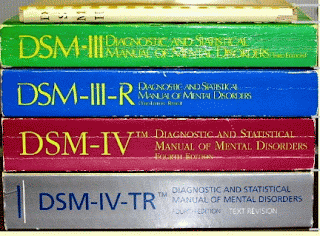
Over the past couple of decades, the DSM has risen from its humble origin to an object of worship, regarded as the absolute scientific truth. Privately, however, many mental health professionals refer to it as a "joke." That's partly because we are aware of studies showing the poor validity of many of its constructs. It's also because we know about some of the forces (in addition to scientific progress) that influence each new edition. These include internal turf wars (the DSM-III was developed in large part to decrease the power of the psychoanalytic wing of psychiatry), cultural fads, group-think, and outside lobbying. And leading the outside lobbying, of course, is the pharmaceutical industry.

An example of how this process works is the case of shyness. Christopher Lane, an English professor and Guggenheim fellow, shows in his book, Shyness: How Normal Behavior Became a Sickness, how psychiatrists transformed shyness from a normal personality trait into a pathological condition labeled Social Anxiety Disorder. As Lane points out, not only can diagnoses be manufactured out of whole cloth, but their prevalence can be made to rise and fall like the stock market through arbitrary adjustments of the threshold cutoffs. And the DSM has a very low bar for calling something a disorder.

In writing his book, Lane was able to get unprecedented access to internal memos and letters of the American Psychiatric Association's DSM-III task force. Based on these primary sources, he credits the rise of the DSM from an obscure tract used mainly by state hospital hacks to an international bible to one man - Robert Spitzer - who chaired the task force and handpicked its members from people he considered "kindred spirits." (Spitzer is perhaps better known among the general public for his controversial stance that gay people could be turned heterosexual through reparative therapy.)
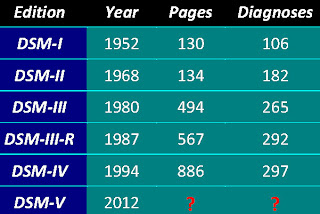
Over the years, the DSM has expanded from just 106 pages to its current 886. (See chart.) The severe mental disorders that once formed the book's core are still in there. There's just so much fluff that it's harder to find them.

And now, the American Psychiatric Association is at it again, working on the fifth edition that is set to launch in May 2012. But this time, perhaps in response to exposes such as Lane's, there will be no telltale memos and letters to document the process. Task force members are sworn to complete secrecy; they must sign a "confidentiality agreement" prohibiting them from disclosing anything to anyone.

Petition drive against secrecy

Ironically, even DSM-III architect Robert Spitzer is being excluded this time around. Denied access to task force committee minutes and other information, an angry Spitzer wrote a protest editorial that was rejected for publication by the American Journal of Psychiatry, the official journal of the American Psychiatric Association. (The editorial, "Developing DSM-V in Secret," is online here). With psychologist Scott Lilienfeld and others, Spitzer last month called for a petition drive to force the APA to open up the DSM-V revision process to public observation.

No doubt hoping to forestall such a petition drive, the APA just announced that its Assembly of local branch representatives will vote November 18 on an "action paper" that would encourage less secrecy. The vaguely worded paper calls on the APA's Board of Trustees to "develop policies and processes that balance the need for openness and transparency and the need to protect its intellectual property." If approved by the Assembly, the action paper will go before the association's Board of Trustees in December.

The secrecy issue comes amid mounting controversy over psychiatrists' ties to the drug industry. The U.S. Senate Finance Committee has launched an investigation into whether drug money is compromising the integrity of medical science. Prominent psychiatrist Charles Nemeroff of Emory University, whom critics have nicknamed "Dr. Bling Bling," is at the center of the probe; he reportedly earned millions of dollars from pharmaceutical companies while promoting drugs to heal depression and other emotional problems. (See Sunday's Atlanta Journal-Constitution.)

Perhaps all of this hubbub will encourage the DSM developers to be a bit more circumspect with new diagnoses, realizing that a massively overmedicated and increasingly cynical public could get fed up.

Perhaps the DSM's stranglehold on diagnosis would not be so serious if the book were only being used for its original and stated purpose, as a tool to help clinicians speak the same language in their efforts to understand and treat the mentally ill. But, increasingly, both medical and psychiatric disorders are being shaped by and for the pharmaceutical industry. (A good example of Big Pharma's influence over medical doctors is The rise of Viagra: How the little blue pill changed sex in America.) And in the forensic arena, the DSM is often employed pretextually, to accomplish various legal outcomes.

Proposed new diagnoses

So, what is in store this time around? Here's my sampling of some of the more controversial changes and new conditions being proposed, some with very specific relevance to forensic practice:

Parental Alienation Syndrome: This is by far the most controversial theory in high-conflict child custody litigation. And the battle lines are drawn primarily by gender: PAS is apt to be the first line of defense when a husband is accused in a custody battle of sexually abusing his children. Despite its lack of empirical support, a partisan lobby is pushing for its inclusion. (See my March 2008 blog post, "Showdown looming over controversial theory," for more background.)

Hebephilia: All psychodiagnoses, even those of psychotic disorders, have serious conceptual validity problems, but none are weaker than some of those being used to justify the civil commitment of sexually violent predators. The latest, and most farcical, is "hebephilia," or the sexual attraction to teens, which is being aggressively marketed by a small advocacy group. (I'll have more to say about this newly proposed diagnosis very soon; for now, you can check out my Halloween 2007 post, "Invasion of the hebephile hunters.")

Gender Identity Disorder: The proposed inclusion of this category has drawn the most fire, primarily from transgender activists, who have mounted a petition drive against Ken Zucker, chair of the sexual disorders task force. Information on this controversy can be found here, here, and here.

Among other novel constructs proposed for inclusion in the DSM-V are Internet Addiction and Relationship Disorder. If Big Pharma has its way, Female Sexual Dysfunction (FSD) could also be a contender (see my Amazon review of The Rise of Viagra). In addition, there are proposals to tweak the criteria for existing diagnoses relevant to forensic practice, including the sexual Paraphilias, Posttraumatic Stress Disorder, and Conduct Disorder.

For more information see:

Robert Spitzer’s documents criticizing the DSM-V secrecy (online here)

The APA’s official DSM-V website (here)

A critical analysis of psychodiagnosis more broadly (here)

My review of Christopher Lane's book, Shyness: How Normal Behavior Became a Sickness, is here. (As always, I encourage my readers and subscribers to click on the "yes" button if you find my Amazon reviews helpful; it helps get the word out.)

For further information on the pharmaceutical industry's role in the process, see my May 2008 blog post, "Who will write the next DSM?" and also check out my Amazon booklist, "Psychiatry and science: Critical perspectives."

Other academic articles on DSM diagnosis (not all of them available online, unfortunately) include:

Andreasen, N.C. (2007). DSM and the death of phenomenology in America: An example of unintended consequences. Schizophrenia Bulletin, 33, 108-112

Cunningham, M.D., & Reidy, T.J. (1998). Antisocial personality disorder and psychopathy: Diagnostic dilemmas in classifying patterns of antisocial behavior in sentencing evaluations. 16, 333-351.

Healy, D. Apr 15, 2006. The myth of 'mood stabilising' drugs. New Scientist (David Healy is a very controversial figure in this debate; Google his name for more on him)

Ruocco, A. (2005). Reevaluating the distinction between Axis I and Axis II disorders: The case of borderline personality disorder. Journal of Clinical Psychology, 61, 1509-1523

Stevens, G.F. (1993). Applying the Diagnosis Antisocial Personality to Imprisoned Offenders: Looking for Hay in a Haystack. Journal of Offender Rehabilitation, 19, 1-26

Tom Zander, Psy.D. (2005) Civil commitment without psychosis: The law's reliance on the weakest links in psychodiagnosis. Journal of Sex Offender Civil Commitment: Science and the Law (online here)

The photo of the DSM manuals is from the Bonkers Institute for Nearly Genuine Research, a very creative website.

October 12, 2008

Goldilocks and the 3 Bears


When the Bear family came home from an evening of foraging at the local Chinese buffet, Mama Bear noticed that someone had been eating in her kitchen.

"Who ate the crab cake and left the crumbs on the counter?" she asked.

"Not I," said Papa Bear.

"Not I," said Baby Bear.

Papa Bear went upstairs and saw that someone had been sleeping in his bed. In fact, that someone was still sleeping, curled up in Papa Bear's blanket on the bed, with his shoes, socks, and pants lying on the floor.

"Who's been sleeping in my bed?" Papa Bear asked.

No, wait a minute, scratch that. Modern bears have cell phones. So Papa Bear did not confront the intruder. Instead, he quietly crept downstairs, gathered up Mama Bear and Baby Bear, and went outside to call the police.

Goldilocks was still asleep when police rolled up.

"What are you doing in my house?" demanded the brazen, modern-day Goldilocks of police.

As it turns out, poor Goldilocks was a 50-year-old man who - with the recent economic downturn - had just lost his job. He was apparently so drunk that he entered the wrong bed in the wrong house. In fact, he got off the bus a full eight miles from his own home in Damascus, Maryland.

The drunken Goldilocks was apologetic.

"I'm so sorry. I'm so sorry," he told the Bears. "And by the way, you have a very comfortable bed."

The modern-day Bears were also a good deal more charitable than in the original tale.

Mama Bear, a middle school teacher named Joanne Breiner, packed up a container of homemade chicken soup, homemade cookies, and spareribs for Goldilocks.

"I think her mom would have been disappointed if we didn't feed the intruder," said Papa Bear (aka Bob Breiner).

In the modern saga, by the way, Baby Bear was 16 years old and had carelessly left the front door unlocked.

Police would not reveal Goldilocks' real name, saying only that he had no criminal record.

Why am I posting about Goldilock and the Bears?

Because in forensic psychology we sometimes get cases like this. Indeed, I had a case very similar to this one, except the Goldilocks in my case was arrested and prosecuted for burglary. In my case, Goldilocks had not been drinking; rather, he was sleepwalking while in an altered state due to an extremely high fever. His charges were dismissed based on witness accounts of his illness, medical records that substantiated his fever and lack of blood-alcohol, and his documented history of somnambulism (sleepwalking).

In the forensic context, the Diagnostic and Statistical Manual of Mental Disorders (DSM) cautions about the possibility of malingering - or faking - of such fugue-like states in order to avoid criminal responsibility.

"Criminal conduct that is bizarre or with little actual gain may be more consistent with a true dissociative disturbance," states the DSM-IV-TR.

That must have been what police concluded in Goldlilocks' case. Instead of arresting the embarrassed fellow, they released him to his wife. After all, most burglars don't just eat the crabcake and go to bed.

The Washington Post has the story.