"The less you know about how mental health is defined, the better. Or perhaps it's the other way around."
In case you missed English professor Christopher Lane's excellent opinion piece in the L.A. Times last week, the Minneapolis Star Tribune ran it this Sunday. As the American Psychiatric Association gears up for DSM-V, we all need to keep it real when it comes to psychiatric diagnosis. Let's hope this media spotlight will encourage the APA to increase the transparency of the process and make sure only legitimate diagnoses get added to the manual.
The Star Tribune op-ed is online here.

November 24, 2008
November 22, 2008
Don’t blame me - AT&T did it!
(Or, my variation on the TODDI defense*)
Loyal subscribers may have noticed an absence of blog posts this week. It's true that I have been busy, but the dearth is partly the fault of AT&T, which shut me down earlier this week.
When I called to find out why my Internet service (and, more urgently, my incoming business telephone line!) was dead, they sent me on a wild goose chase to purchase new equipment.
It took dozens of phone calls, hours of time "on hold," and a two-day wait before they finally sent out a repair person. As it turns out, a technician working on a central terminal up the street had accidentally snipped off my line and spliced me into someone else's.
Accidents happen. And when I complained about the lengthy delay, the good folks at AT&T did compensate me -- to the tune of $16.79.
Sorry 'bout that, folks.
* The TODDI Defense -- The Other Dude Did It -- was one of the most common defenses I heard when I worked as a criminal investigator.
November 16, 2008
Wrangling over psychiatry's bible
Check out this opinion piece in today's Los Angeles Times. (It cites yours truly on the forensic angle.) The writer, Christopher Lane, is the author of an excellent book on the making of the DSM-III, entitled Shyness: How normal behavior became a sickness.
As I have blogged about previously, one example of a proposed diagnosis with no established reliability or validity is "hebephilia." My response to the attempt to get that term added to the DSM-V was just published in the Archives of Sexual Behavior. You can see a free preview (the first page) of "The Public Policy Implications of 'Hebephilia' " here, but you need a subscription to get the entire article.
My blog post on the DSM-V revision process is here.
Los Angeles TimesLane's full opinion piece is online here.
November 16, 2008
By Christopher Lane
Over the summer, a wrangle between eminent psychiatrists that had been brewing for months erupted in print. Startled readers of Psychiatric News saw the spectacle unfold in the journal's normally less-dramatic pages. The bone of contention: whether the next revision of America's psychiatric bible, the "Diagnostic and Statistical Manual of Mental Disorders," should be done openly and transparently so mental health professionals and the public could follow along, or whether the debates should be held in secret.
One of the psychiatrists (former editor Robert Spitzer) wanted transparency; several others, including the president of the American Psychiatric Association and the man charged with overseeing the revisions (Darrel Regier), held out for secrecy. Hanging in the balance is whether, four years from now, a set of questionable behaviors with names such as "Apathy Disorder," "Parental Alienation Syndrome," "Premenstrual Dysphoric Disorder," "Compulsive Buying Disorder," "Internet Addiction" and "Relational Disorder" will be considered full-fledged psychiatric illnesses.
This may sound like an arcane, insignificant spat about nomenclature. But the manual is in fact terribly important, and the debates taking place have far-reaching consequences. Published by the American Psychiatric Association (and better known as the DSM), the manual is meant to cover every mental health disorder that affects children and adults.
Not only do mental health professionals use it routinely when treating patients, but the DSM is also a bible of sorts for insurance companies deciding what disorders to cover, as well as for clinicians, courts, prisons, pharmaceutical companies and agencies that regulate drugs. Because large numbers of countries, including the United States, treat the DSM as gospel, it's no exaggeration to say that minor changes and additions have powerful ripple effects on mental health diagnoses around the world.
Behind the dispute about transparency is the question of whether the vague, open-ended terms being discussed even come close to describing real psychiatric disorders. To large numbers of experts, apathy, compulsive shopping and parental alienation are symptoms of psychological conflict rather than full-scale mental illnesses in their own right. Also, because so many participants in the process of defining new disorders have ties to pharmaceutical companies, some critics argue that the addition of new disorders to the manual is little more than a pretext for prescribing profitable drugs.
The more you know about how psychiatrists defined dozens of disorders in the recent past, the more you can appreciate Spitzer's concern that the process should not be done in private. Although a new disorder is supposed to meet a host of criteria before being accepted into the manual, one consultant to the manual's third edition -- they're now working on the fifth -- explained to the New Yorker magazine that editorial meetings over the changes were often chaotic. "There was very little systematic research," he said, "and much of the research that existed was really a hodgepodge -- scattered, inconsistent and ambiguous. I think the majority of us recognized that the amount of good, solid science upon which we were making our decisions was pretty modest."
Things are different today, the new consultants insist, because hard science now drives their debates. Maybe so, but still, I shudder to think what the criteria for "Relational Disorder" and "Parental Alienation Syndrome" will be. And I'm not the only one worrying. Spitzer is bothered by the prospect of "science by committee." Others, like forensics expert Karen Franklin, writing in American Chronicle, warn that advocacy groups are pressing for the inclusion of dubious terms that simply don't belong in a manual of mental illnesses….
My concern is the lack of proper oversight. If the proposed new disorders don't receive a full professional airing, including a vigorous debate about their validity, they will be incorporated wholesale into the fifth edition in 2012. Joining the ranks of the mentally ill will be the apathetic, shopaholics, the virtually obsessed and alienated parents. It's hard to imagine that anyone will be left who is not eligible for a diagnosis.
Christopher Lane, a professor of English at Northwestern University, is the author of "Shyness: How Normal Behavior Became a Sickness."
As I have blogged about previously, one example of a proposed diagnosis with no established reliability or validity is "hebephilia." My response to the attempt to get that term added to the DSM-V was just published in the Archives of Sexual Behavior. You can see a free preview (the first page) of "The Public Policy Implications of 'Hebephilia' " here, but you need a subscription to get the entire article.
My blog post on the DSM-V revision process is here.
November 13, 2008
The Jury Expert
The new issue of The Jury Expert (a publication of the American Society of Trial Consultants) is now online. Articles include:
Cross-examining the narcissistic witness
A follow-up to a previous Jury Expert article on preparing the narcissist to testify, this article focuses on how to cross-examine narcissistic witnesses.
Conceptual persuasion
A primer on the impact of graphics.
Juror reactions to successful women
Mitigating negative judgments by jurors about successful women attorneys, plaintiffs, defendants (or expert witnesses?)
Do liberals and conservatives punish differently?
Of course they do. This article explains the different themes of interest to jurors of different political persuasions.
The full issue is available here.
Cross-examining the narcissistic witness

A follow-up to a previous Jury Expert article on preparing the narcissist to testify, this article focuses on how to cross-examine narcissistic witnesses.
Conceptual persuasion
A primer on the impact of graphics.
Juror reactions to successful women
Mitigating negative judgments by jurors about successful women attorneys, plaintiffs, defendants (or expert witnesses?)
Do liberals and conservatives punish differently?
Of course they do. This article explains the different themes of interest to jurors of different political persuasions.
The full issue is available here.
November 12, 2008
Incompetent bank robber cannot be forcibly medicated, court rules
I just came back from evaluating a convicted prisoner to see if he is competent to proceed with his appeal. He has been found "gravely disabled" and is being forcibly injected with an antipsychotic medication (Haldol Decanoate).
He was refusing to eat because he thought the food was poisoned. But what if he was eating his food and behaving himself, but still quietly harbored paranoid delusions?
That's when Sell would come in.
As many of you know, under the 2003 case of the Sell v. United States, for a defendant to be forcibly medicated to restore competency, a court must find that:
In New Jersey, a federal judge just ruled that the government did not meet the burden of proving those things in the case of a paranoid bank robbery defendant named Wayne Moruzin. Prosecutors had claimed there was a good chance that Haldol injections would stop his paranoia and hallucinations and make Moruzin fit for trial. But a U.S. District Court judge said they didn't provide enough evidence of that, considering the health dangers of antipsychotics such as Haldol.
I've never met anyone who liked taking Haldol. It makes you feel like a drugged-out zombie, and it can cause severe and permanent health problems.
But such a ruling always leads to the question, what will happen next? The government can try to civilly commit Moruzin, or they can just wait and see if he gets better - which is unlikely without medication.
The ruling parallels a U.S. District Court decision in January of 2007 involving a different mentally ill bank robber. In that case, though, the robber had already pleaded guilty in three other bank heists and was serving a 36-year sentence.
The cases don't break new legal ground, but they do continue an interesting trend.
The New Jersey Law Journal report on the Moruzin case is available online at law.com.
He was refusing to eat because he thought the food was poisoned. But what if he was eating his food and behaving himself, but still quietly harbored paranoid delusions?
That's when Sell would come in.
As many of you know, under the 2003 case of the Sell v. United States, for a defendant to be forcibly medicated to restore competency, a court must find that:
- important government interests are at stake
- involuntary medication will significantly further those interests by being "substantially likely" to restore the defendant's competency
- the medication is substantially unlikely to have negative side effects
- the medication is medically appropriate
In New Jersey, a federal judge just ruled that the government did not meet the burden of proving those things in the case of a paranoid bank robbery defendant named Wayne Moruzin. Prosecutors had claimed there was a good chance that Haldol injections would stop his paranoia and hallucinations and make Moruzin fit for trial. But a U.S. District Court judge said they didn't provide enough evidence of that, considering the health dangers of antipsychotics such as Haldol.
I've never met anyone who liked taking Haldol. It makes you feel like a drugged-out zombie, and it can cause severe and permanent health problems.
But such a ruling always leads to the question, what will happen next? The government can try to civilly commit Moruzin, or they can just wait and see if he gets better - which is unlikely without medication.
The ruling parallels a U.S. District Court decision in January of 2007 involving a different mentally ill bank robber. In that case, though, the robber had already pleaded guilty in three other bank heists and was serving a 36-year sentence.
The cases don't break new legal ground, but they do continue an interesting trend.
The New Jersey Law Journal report on the Moruzin case is available online at law.com.
November 8, 2008
NYT reports on public defender crisis
The current budget crisis is adding to the inequities in the criminal justice system. As workloads mount and budgets decrease, public defenders across the nation find themselves unable to adequately represent their impoverished clients. On Sunday, the New York Times reported on the catastrophe:
Citing Rising Workload, Public Lawyers Reject Cases
By ERIK ECKHOLM
MIAMI — Public defenders' offices in at least seven states are refusing to take on new cases or have sued to limit them, citing overwhelming workloads that they say undermine the constitutional right to counsel for the poor.
Public defenders are notoriously overworked, and their turnover is high and their pay low. But now, in the most open revolt by public defenders in memory, the government appointed lawyers say budget cuts and rising caseloads have pushed them to the breaking point.
Citing Rising Workload, Public Lawyers Reject Cases
By ERIK ECKHOLM
MIAMI — Public defenders' offices in at least seven states are refusing to take on new cases or have sued to limit them, citing overwhelming workloads that they say undermine the constitutional right to counsel for the poor.
Public defenders are notoriously overworked, and their turnover is high and their pay low. But now, in the most open revolt by public defenders in memory, the government appointed lawyers say budget cuts and rising caseloads have pushed them to the breaking point.
The full article in Sunday's New York Times is here.
Don’t Tase Me, Bro!
Have you ever:
It's all documented by Phil Leggiere on the new civil libertarian blog, "Don’t Tase Me, Bro!"
Check it out here. If you like it, you can add it to your feeds.
- Drawn a picture of an SUV?
- Worn a hoodie?
- Refused an order to sod your lawn?
- Given the wrong account of history?
It's all documented by Phil Leggiere on the new civil libertarian blog, "Don’t Tase Me, Bro!"
Check it out here. If you like it, you can add it to your feeds.
November 7, 2008
5th-grader suspended for vampire drawing
Perhaps I am too fixated on Halloween (I promise to stop now!), but I found this story out of Savannah, Georgia fascinating, with its hysterical and racist undertones. Of course, this 5th-grader's troubles were nothing compared to what happened to high schooler Tim Masters when he drew scary pictures.
Halloween drawing scares teacher, gets student in hot water
 Fifth-grader Jordan Hood thought the bloody vampire he drew in art class was scary, but he had no idea it would elicit a horrifying response from one of his teachers.
Tuesday morning, Jordan was assigned to draw a scary Halloween mask in art class.
By the end of the day, Jordan was being told he could not return to Pooler Elementary School until he passed a psychological evaluation....
During art class Tuesday, Jordan drew a scarred vampire with bloodshot eyes and with blood dripping from its nose, mouth and down its cheeks. Art teacher Lloyd Harold helped the boy shade the sketched eyes to give the drawing an even creepier look.
"The assignment was to draw a scary mask or picture - basically a Halloween activity," Harold said.
As a final gory touch, Jordan used a red marker to write "I Kill For Blood" under his drawing.
The picture was not destined for the cover of Fangoria magazine, but it fulfilled the requirement for fifth-grade Halloween art.
However, when Jordan's homeroom teacher, Melissa Pevey, saw the drawing, she found it disturbing. Pevey was concerned enough to contact assistant principal Valerie Johnson and Campus Police.
But it wasn't blood and gore that bothered Pevey.
She believed the blood looked a lot like gang-related teardrop tattoos, and she thought the words "I Kill For Blood" could be tied to an infamous Los Angeles street gang known as The Bloods.
Jordan's mother, LaKisha Hood, was shocked to find that her son's art lesson had evolved into a gang investigation.
"They told me the droplets could actually be a gang symbol for the number of people he killed," she said.
Burnsed said the district has asked teachers to be wary of anything that might be harmful to students. He also said the district has provided gang-identification training.
He did not know whether classroom teachers were trained in gang symbolism.
"The teacher was concerned and referred it to the Campus Police," Burnsed said. "(Campus Police Capt. Joan) Sasser wasn't sure that it meant anything."
So they resolved the issue by requiring Jordan to undergo psychological testing with Gateway Mental Health.
Jordan's family didn't want him to miss school, so he went in for testing first thing Wednesday morning - getting him back to school in time for the fall dance that afternoon.
Although he only lost about two hours of instruction, his mother fears the incident also might cost him a bit of innocence and trust.
"He didn't know anything about gang symbols until the teacher accused him," she said. "We moved to Pooler thinking he'd be in a more diverse school with better opportunities.
"And so far, it hasn't been a pleasant experience."
The full story is here. I have previously highlighted the story of Tim Masters, who was convicted of murder in large part due to a series of "scary doodles."
Halloween drawing scares teacher, gets student in hot water
 Fifth-grader Jordan Hood thought the bloody vampire he drew in art class was scary, but he had no idea it would elicit a horrifying response from one of his teachers.
Tuesday morning, Jordan was assigned to draw a scary Halloween mask in art class.
By the end of the day, Jordan was being told he could not return to Pooler Elementary School until he passed a psychological evaluation....
During art class Tuesday, Jordan drew a scarred vampire with bloodshot eyes and with blood dripping from its nose, mouth and down its cheeks. Art teacher Lloyd Harold helped the boy shade the sketched eyes to give the drawing an even creepier look.
"The assignment was to draw a scary mask or picture - basically a Halloween activity," Harold said.
As a final gory touch, Jordan used a red marker to write "I Kill For Blood" under his drawing.
The picture was not destined for the cover of Fangoria magazine, but it fulfilled the requirement for fifth-grade Halloween art.
However, when Jordan's homeroom teacher, Melissa Pevey, saw the drawing, she found it disturbing. Pevey was concerned enough to contact assistant principal Valerie Johnson and Campus Police.
But it wasn't blood and gore that bothered Pevey.
She believed the blood looked a lot like gang-related teardrop tattoos, and she thought the words "I Kill For Blood" could be tied to an infamous Los Angeles street gang known as The Bloods.
Jordan's mother, LaKisha Hood, was shocked to find that her son's art lesson had evolved into a gang investigation.
"They told me the droplets could actually be a gang symbol for the number of people he killed," she said.
Burnsed said the district has asked teachers to be wary of anything that might be harmful to students. He also said the district has provided gang-identification training.
He did not know whether classroom teachers were trained in gang symbolism.
"The teacher was concerned and referred it to the Campus Police," Burnsed said. "(Campus Police Capt. Joan) Sasser wasn't sure that it meant anything."
So they resolved the issue by requiring Jordan to undergo psychological testing with Gateway Mental Health.
Jordan's family didn't want him to miss school, so he went in for testing first thing Wednesday morning - getting him back to school in time for the fall dance that afternoon.
Although he only lost about two hours of instruction, his mother fears the incident also might cost him a bit of innocence and trust.
"He didn't know anything about gang symbols until the teacher accused him," she said. "We moved to Pooler thinking he'd be in a more diverse school with better opportunities.
"And so far, it hasn't been a pleasant experience."
The full story is here. I have previously highlighted the story of Tim Masters, who was convicted of murder in large part due to a series of "scary doodles."
Hat tip: The excellent blog, Don't taze me, Bro!
November 3, 2008
Movie recommendation: The Changeling
 The Changeling is a powerful film. It tells the long-forgotten story of a working-class woman who brought down the corrupt establishment of Los Angeles 80 years ago.
Angelina Jolie gives a strong, Oscar-worthy performance as Christine Collins, a single mother and one of the first female supervisors at the phone company who refuses to bow down to corrupt police when her son vanished without a trace in 1928.
 Los Angeles on the brink of the Great Depression was an epitome of corruption. The police chief, James "Two Guns" Davis, had an officially sanctioned "gun squad" that terrorized opponents with impunity. When Collins' son Walter vanished, the L.A. police were embarrassed by their inability to find him. To squelch public criticism, they tried to convince Collins that a young drifter was her son. When Collins protested, police Captain J.J. Jones labeled her as histrionic and delusional and had her locked in a "psychopathic ward."
Luckily for Collins, her plight came to the attention of Gustav A. Briegleb, a Presbyterian minister and community organizer who regularly lambasted police corruption on his radio show. It was through Briegleb's help that Collins was able to get a lawyer and tell her story. Indeed, although it is not mentioned in the movie, Collins' case led to passage of a law that prohibited police from incarcerating people in psychiatric facilities absent due process.
My review continues here (click to the Amazon page and then scroll down to the customer reviews; please click on "yes" if you find the review helpful).
October 31, 2008
Pendulum swing on Halloween hype?
In a counterpoint to my Halloween post yesterday, Grits for Breakfast has a roundup of critiques of the "annual, mostly fact-free media hype surrounding registered sex offenders and Halloween." Comedy shows such as Saturday Night Live and Jay Leno deserve some of the credit for lampooning the ridiculous restrictions and causing some officials to back down.
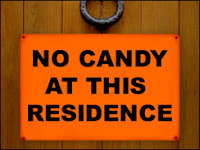 For example, after being the butt of jokes on Saturday Night Live, officials in Maryland backed off of their annual ritual of forcing registered sex offenders to post a bright orange sign on their doors, stating in capital letters: "NO CANDY AT THIS RESIDENCE."
"Laughing at stupid public policies is sometimes the best way to influence public opinion, so I'm glad to know the Saturday Night Live piece struck a nerve and many in the public apparently see through the hype. After all, trick or treaters are statistically much more likely to be hit by lightning than molested by a registered sex offender while soliciting candy," comments Scott Henson over at Grits.
Henson calls the farcical crackdowns an example of "security theater," or "hyping (and pretending to solve) a threat that in reality is extremely remote, even to the point of diverting resources from policing activities like DWI enforcement that would protect more people and save more lives."
Another sign that the pendulum may be swinging was a U.S. District Court judge's grant of temporary injunctions against two provisions of a Missouri law banning sex offenders from having any "Halloween-related contact" with children.
Judge Carol Jackson called the provisions unconstitutionally vague. According to the Wall Street Journal's law blog, the judge was concerned that sex offenders might be punished for engaging in Halloween-related activities with their own children, such as "carving a pumpkin in the privacy of your kitchen with your 5-year-old child." She questioned whether such parents might have to send their kids away on Halloween to avoid prosecution.
The challenge was brought by the ACLU of Eastern Missouri on behalf of four convicted sex offenders. As I reported on Tuesday, civil rights attorneys are devoting more and more of their resources to protecting the rights of society's most vilified citizens; these lawyers will deserve the lion's share of credit if the pendulum does begin to swing back toward rationality.
Speaking at last week's Association for the Treatment of Sexual Abusers (ATSA) conference in Atlanta, attorney Sarah Geraghty of the Southern Center for Human Rights said she never would have foreseen that her career would take this direction, but she is happy that it did because she thinks she has found her life's calling.
Grits for Breakfast has extensive coverage and links on the Halloween hysteria and responses.
 For example, after being the butt of jokes on Saturday Night Live, officials in Maryland backed off of their annual ritual of forcing registered sex offenders to post a bright orange sign on their doors, stating in capital letters: "NO CANDY AT THIS RESIDENCE."
"Laughing at stupid public policies is sometimes the best way to influence public opinion, so I'm glad to know the Saturday Night Live piece struck a nerve and many in the public apparently see through the hype. After all, trick or treaters are statistically much more likely to be hit by lightning than molested by a registered sex offender while soliciting candy," comments Scott Henson over at Grits.
Henson calls the farcical crackdowns an example of "security theater," or "hyping (and pretending to solve) a threat that in reality is extremely remote, even to the point of diverting resources from policing activities like DWI enforcement that would protect more people and save more lives."
Another sign that the pendulum may be swinging was a U.S. District Court judge's grant of temporary injunctions against two provisions of a Missouri law banning sex offenders from having any "Halloween-related contact" with children.
Judge Carol Jackson called the provisions unconstitutionally vague. According to the Wall Street Journal's law blog, the judge was concerned that sex offenders might be punished for engaging in Halloween-related activities with their own children, such as "carving a pumpkin in the privacy of your kitchen with your 5-year-old child." She questioned whether such parents might have to send their kids away on Halloween to avoid prosecution.
The challenge was brought by the ACLU of Eastern Missouri on behalf of four convicted sex offenders. As I reported on Tuesday, civil rights attorneys are devoting more and more of their resources to protecting the rights of society's most vilified citizens; these lawyers will deserve the lion's share of credit if the pendulum does begin to swing back toward rationality.
Speaking at last week's Association for the Treatment of Sexual Abusers (ATSA) conference in Atlanta, attorney Sarah Geraghty of the Southern Center for Human Rights said she never would have foreseen that her career would take this direction, but she is happy that it did because she thinks she has found her life's calling.
Grits for Breakfast has extensive coverage and links on the Halloween hysteria and responses.
October 30, 2008
Beware the Halloween bogeyman!
This Halloween, as vampires, ghosts, witches, and other fearsome creatures stalk the night, communities are gearing up for an even more horrendous monster, the most evil and terrifying of them all. It's .... eeeeeek .......

On Halloween, communities around the United States are taking drastic and unprecedented steps to keep vulnerable young children safe from this lurking menace:
"We believe that Halloween is for little children," said the town's mayor, Mark Eckert. "We just feel that we need to go that extra mile to protect the children."
And there's the rub. Fear and hype notwithstanding, there is not one single case on record of a child being sexually molested by a registered sex offender while trick-or-treating on Halloween.
In that regard, the current sex offender scare has much in common with the Halloween legend of tainted candy.
As Benjamin Radford of the Skeptical Enquirer pointed out about that enduring stranger-danger myth: "Despite e-mail warnings, scary stories, and Ann Landers columns to the contrary, there have been only two confirmed cases of children being killed by poisoned Halloween candy, and in both cases the children were killed not in a random act by strangers but intentional murder by one of their parents."
The sad part of both myths is that children are taught a message of fear: Strangers, or even their own neighbors, might try to poison or molest them.
The real danger facing children this Halloween is getting hit by a car while crossing a dark street.
That, and dental cavities.
Also see the essay by Benjamin Radford in LiveScience , "Halloween Hysteria: Phantom Fears and Sex Offenders."
Graphics credit: Zombophoto (Creative Commons license).
Note: This post is back by popular demand from last year's Halloween essay; the Belleville law is new, but all the rest of those listed above were in place last year. This year, you can bet that even more states and municipalities will have jumped on the bandwagon. Feel free to post new ones that you may know about in the "Comments" section.

THE SEXUAL PREDATOR!
On Halloween, communities around the United States are taking drastic and unprecedented steps to keep vulnerable young children safe from this lurking menace:
- In Roanoke, Virginia, and Anderson, South Carolina, convicted sex offenders will be rounded up and held at a single location.
- In Tennessee, sex offenders are being forbidden from wearing costumes or handing out candy to trick-or-treaters.
- In Maryland, registered offenders are being required to post "No Candy" signs on their doors.
- In Harris County, Texas, sheriff’s deputies are cruising the streets, ready to arrest any sex offender with Halloween decorations on his home.
- In California and Illinois, paroled offenders must turn off all outside lights, stay in their homes from 5 p.m. to 5 a.m., and not answer their doors except to police.
"We believe that Halloween is for little children," said the town's mayor, Mark Eckert. "We just feel that we need to go that extra mile to protect the children."
And there's the rub. Fear and hype notwithstanding, there is not one single case on record of a child being sexually molested by a registered sex offender while trick-or-treating on Halloween.
In that regard, the current sex offender scare has much in common with the Halloween legend of tainted candy.
As Benjamin Radford of the Skeptical Enquirer pointed out about that enduring stranger-danger myth: "Despite e-mail warnings, scary stories, and Ann Landers columns to the contrary, there have been only two confirmed cases of children being killed by poisoned Halloween candy, and in both cases the children were killed not in a random act by strangers but intentional murder by one of their parents."
The sad part of both myths is that children are taught a message of fear: Strangers, or even their own neighbors, might try to poison or molest them.
The real danger facing children this Halloween is getting hit by a car while crossing a dark street.
That, and dental cavities.
Also see the essay by Benjamin Radford in LiveScience , "Halloween Hysteria: Phantom Fears and Sex Offenders."
Graphics credit: Zombophoto (Creative Commons license).
Note: This post is back by popular demand from last year's Halloween essay; the Belleville law is new, but all the rest of those listed above were in place last year. This year, you can bet that even more states and municipalities will have jumped on the bandwagon. Feel free to post new ones that you may know about in the "Comments" section.


October 29, 2008
The case for videotaping interrogations
Detective's candid call for reform
I've been a police officer for 25 years, and I never understood why someone would admit to a crime he or she didn't commit. Until I secured a false confession in a murder case.
 So begins a Los Angeles Times opinion piece by Jim Trainum, a Washington DC police detective who runs a cold case unit and lectures on interrogations and false confessions and other police investigation topics.
Like most people, Trainum was firmly convinced that only the guilty confess to crimes. And, like most police, he believed his suspect's confession - obtained without threats or abuse - was "solid."
Even after an "ironclad alibi" forced dismissal of charges, the detective and others continued for years to think she was guilty: After all, she had confessed. And even her own attorney thought she was guilty of killing the man, who had been robbed, beaten, and dumped in a river.
Trainum's thinking underwent a dramatic change only years later, when he reviewed the videotape of the mid-1990s confession in light of more contemporary understanding of false confessions:
"We ignored evidence that our suspect might not have been guilty, and during the interrogation we inadvertently fed her details of the crime that she repeated back to us in her confession," he realized.
Trainum's op ed, focusing on the need to videotape interrogations, is here.
I've been a police officer for 25 years, and I never understood why someone would admit to a crime he or she didn't commit. Until I secured a false confession in a murder case.
 So begins a Los Angeles Times opinion piece by Jim Trainum, a Washington DC police detective who runs a cold case unit and lectures on interrogations and false confessions and other police investigation topics.
Like most people, Trainum was firmly convinced that only the guilty confess to crimes. And, like most police, he believed his suspect's confession - obtained without threats or abuse - was "solid."
Even after an "ironclad alibi" forced dismissal of charges, the detective and others continued for years to think she was guilty: After all, she had confessed. And even her own attorney thought she was guilty of killing the man, who had been robbed, beaten, and dumped in a river.
Trainum's thinking underwent a dramatic change only years later, when he reviewed the videotape of the mid-1990s confession in light of more contemporary understanding of false confessions:
"We ignored evidence that our suspect might not have been guilty, and during the interrogation we inadvertently fed her details of the crime that she repeated back to us in her confession," he realized.
Trainum's op ed, focusing on the need to videotape interrogations, is here.
October 28, 2008
Georgia sex offender law unconstitutional
At last week's Association for the Treatment of Sexual Abusers (ATSA) conference in Atlanta, Sarah Geraghty of the Southern Center for Human Rights gave a compelling talk about the inhumanity of Georgia’s sex offender laws, the most draconian in the nation.
Blog readers may recall that Georgia is the state that made devoted mother Janet Allison a homeless, jobless leper simply for allowing her daughter's boyfriend to move into the family home after the daughter became pregnant. (See "Sex Offender Laws Gone Amok, April 10, 2007.)
In Alaska, as national news demonstrates, she might be congratulated. But not in Georgia.
The explicit goal of Georgia legislature was to force all sex offenders to leave the state. And no one was harder hit than the homeless. Homeless offenders were criminalized for not having a valid address to supply to the registry. The second such offense was punishable by life in prison. Yes, you read that right. Life in prison.
Almost as soon as the eloquent Ms. Geraghty left the ATSA podium, however, Georgia's Supreme Court struck down the homelessness provision of the law. In Monday's 6-1 decision, the court found the law unconstitutional because it fails to give homeless offenders a mechanism to comply.
Geraghty's group had brought the case on behalf of William James Santos, who was kicked out of a Gainesville homeless shelter and then arrested for failing to register with Georgia's sex offender list.
As reported in the New York Times, this is one of several challenges to the 2006 law.
Geraghty told the ATSA convention that it won't be the last. Around the nation, she is seeing signs of change; courts in several states have struck down various provisions of the new laws.
The case, Santos v. State, is online here.
Blog readers may recall that Georgia is the state that made devoted mother Janet Allison a homeless, jobless leper simply for allowing her daughter's boyfriend to move into the family home after the daughter became pregnant. (See "Sex Offender Laws Gone Amok, April 10, 2007.)
In Alaska, as national news demonstrates, she might be congratulated. But not in Georgia.
The explicit goal of Georgia legislature was to force all sex offenders to leave the state. And no one was harder hit than the homeless. Homeless offenders were criminalized for not having a valid address to supply to the registry. The second such offense was punishable by life in prison. Yes, you read that right. Life in prison.
Almost as soon as the eloquent Ms. Geraghty left the ATSA podium, however, Georgia's Supreme Court struck down the homelessness provision of the law. In Monday's 6-1 decision, the court found the law unconstitutional because it fails to give homeless offenders a mechanism to comply.
Geraghty's group had brought the case on behalf of William James Santos, who was kicked out of a Gainesville homeless shelter and then arrested for failing to register with Georgia's sex offender list.
As reported in the New York Times, this is one of several challenges to the 2006 law.
Geraghty told the ATSA convention that it won't be the last. Around the nation, she is seeing signs of change; courts in several states have struck down various provisions of the new laws.
The case, Santos v. State, is online here.
October 27, 2008
Trials of a Forensic Psychologist: A Casebook
 The latest from forensic psychologist Charles Ewing
No sooner do I get done reviewing law professor Charles Ewing's book, Insanity: Murder, Madness, and the Law, than the internationally known forensic psychologist and legal scholar cranks out another one.
Ewing's latest, Trials of a Forensic Psychologist, is also his most autobiographical to date, drawing on his 30 years of experience in the trenches and in some of the nation's most high-profile cases. As such, it promises to be an engaging read as well as good fodder for course instructors.
 "Many people, myself included, have written books examining high-profile controversial cases whose verdicts hinged on the testimony of forensic experts," Ewing said. "My goal in this book was to take that genre one step further. After sorting through the many trials in which I have testified throughout the United States, I selected 10 high-profile cases that were not only fascinating, but allowed me to give readers an intimate and detailed look at my work as a forensic psychologist."
I was interested to see that women are well represented among the 10 cases, which include:
- Waneta Hoyt, who under intense pressure confessed to killing five of her children whose deaths had originally been attributed to Sudden Infant Death Syndrome.
- Judith Neelley, a battered woman and the youngest American woman to serve time on death row, was convicted of committing the heinous murders of two women at the behest of her abusive husband.
- Richard Knupp, charged with over 1,400 counts of sexually abusing his own children, who was first convicted and then exonerated in a second trial.
- Shirley Kinge, whose son murdered a family during a robbery before himself being killed by police. The mother was convicted as an accomplice but was exonerated based on evidence that a prosecution expert had falsified evidence against her and many other criminal defendants.
Ewing, a professor at the University of Buffalo Law School, has several books to his credit, including Fatal Families, Kids Who Kill, and an excellent, co-authored case-study book, "Minds on Trial."
The book's table of contents and excerpts are available here.
Photo credit: Douglas Levere
October 19, 2008
Pseudoscience in policing
The October issue of Criminal Justice and Behavior is a special issue on Pseudoscientific Policing Practices and Beliefs. There are some great articles and, best of all, Sage is offering free access to those of you without access to academic databases through the end of this month.
 As those of you who have been reading my blog for a while know, criminal profiling is one of my pet peeves (See last year's post, "Of profiling, astrology, and magic.") So, my favorite article in the current issue is "The Criminal Profiling Illusion: What's Behind the Smoke and Mirrors?"
The idea that police can deduce a suspect's characteristics from the crime scene has no strong empirical support and may indeed be an illusion, say the authors, Brent Snook, Richard M. Cullen, Craig Bennell, Paul J. Taylor, and Paul Gendreau, who go on to argue that the technique should not be used as an investigative tool:
 There's quite a lineup of scholarly experts behind the other articles in the special issue, too:
 As those of you who have been reading my blog for a while know, criminal profiling is one of my pet peeves (See last year's post, "Of profiling, astrology, and magic.") So, my favorite article in the current issue is "The Criminal Profiling Illusion: What's Behind the Smoke and Mirrors?"
The idea that police can deduce a suspect's characteristics from the crime scene has no strong empirical support and may indeed be an illusion, say the authors, Brent Snook, Richard M. Cullen, Craig Bennell, Paul J. Taylor, and Paul Gendreau, who go on to argue that the technique should not be used as an investigative tool:
There is a belief that criminal profilers can predict a criminal's characteristics from crime scene evidence. In this article, the authors argue that this belief may be an illusion and explain how people may have been misled into believing that criminal profiling (CP) works despite no sound theoretical grounding and no strong empirical support for this possibility. Potentially responsible for this illusory belief is the information that people acquire about CP, which is heavily influenced by anecdotes, repetition of the message that profiling works, the expert profiler label, and a disproportionate emphasis on correct predictions. Also potentially responsible are aspects of information processing such as reasoning errors, creating meaning out of ambiguous information, imitating good ideas, and inferring fact from fiction. The authors conclude that CP should not be used as an investigative tool because it lacks scientific support.
 There's quite a lineup of scholarly experts behind the other articles in the special issue, too:
- Science and Pseudoscience in Law Enforcement: A User-Friendly Primer by Scott O. Lilienfeld and Kristin Landfield
- Reducing Misconceptions and False Beliefs in Police and Criminal Psychology by Michael G. Aamodt
- Logic and Research Versus Intuition and Past Practice as Guides to Gathering and Evaluating Eyewitness Evidence by John Turtle and Stephen C. Want
- Hypnosis and the Law: Examining the Stereotypes by Graham F. Wagstaff
- Effective Policing: Understanding How Polygraph Tests Work and Are Used by William G. Iacono
- Confession Evidence: Commonsense Myths and Misconceptions by Saul M. Kassin
- Nonverbal Dominance Versus Verbal Accuracy in Lie Detection: A Plea to Change Police Practice by Aldert Vrij
- Apprehended Without Warrant: Issues of Evidentiary Warrant for Critical Incident Services and Related Trauma Interventions in a Federal Law Enforcement Agency by Katherine M. Newbold, Jeffrey M. Lohr, and Richard Gist
- Commentary: Sense, Common Sense, and Nonsense by David C. Flagel and Paul Gendreau
Photo credit: Troy & Patrice
October 13, 2008
DSM makeover: What will they come up with next?
Overhaul of diagnostic bible shrouded in secrecy
It's a tried-and-true formula:
1. Do a quick-and-dirty study or two.And, voila! The drug companies will take it from there. A diagnosis that was once just a twinkle in the eye of a creative researcher becomes reified as a concrete entity.
2. Find a huge, perhaps escalating, problem that has heretofore been overlooked.
3. Create a product label (aka diagnosis).
 Over the past couple of decades, the DSM has risen from its humble origin to an object of worship, regarded as the absolute scientific truth. Privately, however, many mental health professionals refer to it as a "joke." That's partly because we are aware of studies showing the poor validity of many of its constructs. It's also because we know about some of the forces (in addition to scientific progress) that influence each new edition. These include internal turf wars (the DSM-III was developed in large part to decrease the power of the psychoanalytic wing of psychiatry), cultural fads, group-think, and outside lobbying. And leading the outside lobbying, of course, is the pharmaceutical industry.
An example of how this process works is the case of shyness. Christopher Lane, an English professor and Guggenheim fellow, shows in his book, Shyness: How Normal Behavior Became a Sickness, how psychiatrists transformed shyness from a normal personality trait into a pathological condition labeled Social Anxiety Disorder. As Lane points out, not only can diagnoses be manufactured out of whole cloth, but their prevalence can be made to rise and fall like the stock market through arbitrary adjustments of the threshold cutoffs. And the DSM has a very low bar for calling something a disorder.
In writing his book, Lane was able to get unprecedented access to internal memos and letters of the American Psychiatric Association's DSM-III task force. Based on these primary sources, he credits the rise of the DSM from an obscure tract used mainly by state hospital hacks to an international bible to one man - Robert Spitzer - who chaired the task force and handpicked its members from people he considered "kindred spirits." (Spitzer is perhaps better known among the general public for his controversial stance that gay people could be turned heterosexual through reparative therapy.)
 Over the years, the DSM has expanded from just 106 pages to its current 886. (See chart.) The severe mental disorders that once formed the book's core are still in there. There's just so much fluff that it's harder to find them.
And now, the American Psychiatric Association is at it again, working on the fifth edition that is set to launch in May 2012. But this time, perhaps in response to exposes such as Lane's, there will be no telltale memos and letters to document the process. Task force members are sworn to complete secrecy; they must sign a "confidentiality agreement" prohibiting them from disclosing anything to anyone.
Petition drive against secrecy
Ironically, even DSM-III architect Robert Spitzer is being excluded this time around. Denied access to task force committee minutes and other information, an angry Spitzer wrote a protest editorial that was rejected for publication by the American Journal of Psychiatry, the official journal of the American Psychiatric Association. (The editorial, "Developing DSM-V in Secret," is online here). With psychologist Scott Lilienfeld and others, Spitzer last month called for a petition drive to force the APA to open up the DSM-V revision process to public observation.
No doubt hoping to forestall such a petition drive, the APA just announced that its Assembly of local branch representatives will vote November 18 on an "action paper" that would encourage less secrecy. The vaguely worded paper calls on the APA's Board of Trustees to "develop policies and processes that balance the need for openness and transparency and the need to protect its intellectual property." If approved by the Assembly, the action paper will go before the association's Board of Trustees in December.
The secrecy issue comes amid mounting controversy over psychiatrists' ties to the drug industry. The U.S. Senate Finance Committee has launched an investigation into whether drug money is compromising the integrity of medical science. Prominent psychiatrist Charles Nemeroff of Emory University, whom critics have nicknamed "Dr. Bling Bling," is at the center of the probe; he reportedly earned millions of dollars from pharmaceutical companies while promoting drugs to heal depression and other emotional problems. (See Sunday's Atlanta Journal-Constitution.)
Perhaps all of this hubbub will encourage the DSM developers to be a bit more circumspect with new diagnoses, realizing that a massively overmedicated and increasingly cynical public could get fed up.
Perhaps the DSM's stranglehold on diagnosis would not be so serious if the book were only being used for its original and stated purpose, as a tool to help clinicians speak the same language in their efforts to understand and treat the mentally ill. But, increasingly, both medical and psychiatric disorders are being shaped by and for the pharmaceutical industry. (A good example of Big Pharma's influence over medical doctors is The rise of Viagra: How the little blue pill changed sex in America.) And in the forensic arena, the DSM is often employed pretextually, to accomplish various legal outcomes.
Proposed new diagnoses
So, what is in store this time around? Here's my sampling of some of the more controversial changes and new conditions being proposed, some with very specific relevance to forensic practice:
Parental Alienation Syndrome: This is by far the most controversial theory in high-conflict child custody litigation. And the battle lines are drawn primarily by gender: PAS is apt to be the first line of defense when a husband is accused in a custody battle of sexually abusing his children. Despite its lack of empirical support, a partisan lobby is pushing for its inclusion. (See my March 2008 blog post, "Showdown looming over controversial theory," for more background.)
Hebephilia: All psychodiagnoses, even those of psychotic disorders, have serious conceptual validity problems, but none are weaker than some of those being used to justify the civil commitment of sexually violent predators. The latest, and most farcical, is "hebephilia," or the sexual attraction to teens, which is being aggressively marketed by a small advocacy group. (I'll have more to say about this newly proposed diagnosis very soon; for now, you can check out my Halloween 2007 post, "Invasion of the hebephile hunters.")
Gender Identity Disorder: The proposed inclusion of this category has drawn the most fire, primarily from transgender activists, who have mounted a petition drive against Ken Zucker, chair of the sexual disorders task force. Information on this controversy can be found here, here, and here.
Among other novel constructs proposed for inclusion in the DSM-V are Internet Addiction and Relationship Disorder. If Big Pharma has its way, Female Sexual Dysfunction (FSD) could also be a contender (see my Amazon review of The Rise of Viagra). In addition, there are proposals to tweak the criteria for existing diagnoses relevant to forensic practice, including the sexual Paraphilias, Posttraumatic Stress Disorder, and Conduct Disorder.
For more information see:
Robert Spitzer’s documents criticizing the DSM-V secrecy (online here)
The APA’s official DSM-V website (here)
A critical analysis of psychodiagnosis more broadly (here)
My review of Christopher Lane's book, Shyness: How Normal Behavior Became a Sickness, is here. (As always, I encourage my readers and subscribers to click on the "yes" button if you find my Amazon reviews helpful; it helps get the word out.)
For further information on the pharmaceutical industry's role in the process, see my May 2008 blog post, "Who will write the next DSM?" and also check out my Amazon booklist, "Psychiatry and science: Critical perspectives."
Other academic articles on DSM diagnosis (not all of them available online, unfortunately) include:
Andreasen, N.C. (2007). DSM and the death of phenomenology in America: An example of unintended consequences. Schizophrenia Bulletin, 33, 108-112
Cunningham, M.D., & Reidy, T.J. (1998). Antisocial personality disorder and psychopathy: Diagnostic dilemmas in classifying patterns of antisocial behavior in sentencing evaluations. 16, 333-351.
Healy, D. Apr 15, 2006. The myth of 'mood stabilising' drugs. New Scientist (David Healy is a very controversial figure in this debate; Google his name for more on him)
Ruocco, A. (2005). Reevaluating the distinction between Axis I and Axis II disorders: The case of borderline personality disorder. Journal of Clinical Psychology, 61, 1509-1523
Stevens, G.F. (1993). Applying the Diagnosis Antisocial Personality to Imprisoned Offenders: Looking for Hay in a Haystack. Journal of Offender Rehabilitation, 19, 1-26
Tom Zander, Psy.D. (2005) Civil commitment without psychosis: The law's reliance on the weakest links in psychodiagnosis. Journal of Sex Offender Civil Commitment: Science and the Law (online here)
October 12, 2008
Goldilocks and the 3 Bears

When the Bear family came home from an evening of foraging at the local Chinese buffet, Mama Bear noticed that someone had been eating in her kitchen.
"Who ate the crab cake and left the crumbs on the counter?" she asked.
"Not I," said Papa Bear.
"Not I," said Baby Bear.
Papa Bear went upstairs and saw that someone had been sleeping in his bed. In fact, that someone was still sleeping, curled up in Papa Bear's blanket on the bed, with his shoes, socks, and pants lying on the floor.
"Who's been sleeping in my bed?" Papa Bear asked.
No, wait a minute, scratch that. Modern bears have cell phones. So Papa Bear did not confront the intruder. Instead, he quietly crept downstairs, gathered up Mama Bear and Baby Bear, and went outside to call the police.
Goldilocks was still asleep when police rolled up.
 "What are you doing in my house?" demanded the brazen, modern-day Goldilocks of police.
As it turns out, poor Goldilocks was a 50-year-old man who - with the recent economic downturn - had just lost his job. He was apparently so drunk that he entered the wrong bed in the wrong house. In fact, he got off the bus a full eight miles from his own home in Damascus, Maryland.
The drunken Goldilocks was apologetic.
"I'm so sorry. I'm so sorry," he told the Bears. "And by the way, you have a very comfortable bed."
The modern-day Bears were also a good deal more charitable than in the original tale.
Mama Bear, a middle school teacher named Joanne Breiner, packed up a container of homemade chicken soup, homemade cookies, and spareribs for Goldilocks.
"I think her mom would have been disappointed if we didn't feed the intruder," said Papa Bear (aka Bob Breiner).
In the modern saga, by the way, Baby Bear was 16 years old and had carelessly left the front door unlocked.
Police would not reveal Goldilocks' real name, saying only that he had no criminal record.
Why am I posting about Goldilock and the Bears?
Because in forensic psychology we sometimes get cases like this. Indeed, I had a case very similar to this one, except the Goldilocks in my case was arrested and prosecuted for burglary. In my case, Goldilocks had not been drinking; rather, he was sleepwalking while in an altered state due to an extremely high fever. His charges were dismissed based on witness accounts of his illness, medical records that substantiated his fever and lack of blood-alcohol, and his documented history of somnambulism (sleepwalking).
In the forensic context, the Diagnostic and Statistical Manual of Mental Disorders (DSM) cautions about the possibility of malingering - or faking - of such fugue-like states in order to avoid criminal responsibility.
"Criminal conduct that is bizarre or with little actual gain may be more consistent with a true dissociative disturbance," states the DSM-IV-TR.
That must have been what police concluded in Goldlilocks' case. Instead of arresting the embarrassed fellow, they released him to his wife. After all, most burglars don't just eat the crabcake and go to bed.
The Washington Post has the story.
October 10, 2008
Sex offender laws criminalizing children
Unintentional wrinkle in sex offender hysteria
 A 15-year-old Ohio girl may have to register as a sex offender for the next 20 years – until she is 35 years old! - because she had the bad judgment to share with her friends some nude photos of herself that she took with her cell phone.
The girl's friends may also be charged in the case.
Under the federal Adam Walsh Act, which I blogged about yesterday, judges lost much of their ability to exercise common-sense discretion in cases like this. Instead, crimes must be punished based on fixed offense categories or "tiers."
The law under which the girl is charged makes it a 5th-degree felony to possess material showing a minor in a state of nudity. There is an exemption for parents or guardians who take nude photos of their own children, but no exemption for a child herself.
The legislator who wrote Ohio's Megan's Law, Republican Jay Hottinger, said this type of case was not what the legislature had in mind.
Maybe, instead of just thinking about getting votes, legislators should have been thinking a bit more carefully and deeply when they drafted all these laws, because this high school girl is far from a fluke.
As an expert on child pornography pointed out at a recent forensic psychology conference in Ireland, much of the sexually explicit imagery on the Internet is uploaded by the youngsters themselves, through such sites as Facebook, YouTube and Bebo; other images, as in this case, are sent from friend to friend via mobile phones.
Dr. Ethel Quayle, director of Europe's Combating Paedophile Information Networks in Europe (COPINE) and author of a book on Internet Child Pornography, estimated that about half of all online sexual solicitation involving children is done by the children themselves.
Dr. Quayle said the stereotype of middle-aged men grooming children for sexual exploitation is way off the mark; laws predicated on this bogeyman image are resulting in the increased criminalization of children like the Ohio girl.
The Newark (Ohio) Advocate has more on the Ohio case. The Irish Examiner reported on the forensic conference at University College Cork in Ireland. Photo credit: Hialean (Creative Commons license).
 A 15-year-old Ohio girl may have to register as a sex offender for the next 20 years – until she is 35 years old! - because she had the bad judgment to share with her friends some nude photos of herself that she took with her cell phone.
The girl's friends may also be charged in the case.
Under the federal Adam Walsh Act, which I blogged about yesterday, judges lost much of their ability to exercise common-sense discretion in cases like this. Instead, crimes must be punished based on fixed offense categories or "tiers."
The law under which the girl is charged makes it a 5th-degree felony to possess material showing a minor in a state of nudity. There is an exemption for parents or guardians who take nude photos of their own children, but no exemption for a child herself.
The legislator who wrote Ohio's Megan's Law, Republican Jay Hottinger, said this type of case was not what the legislature had in mind.
Maybe, instead of just thinking about getting votes, legislators should have been thinking a bit more carefully and deeply when they drafted all these laws, because this high school girl is far from a fluke.
As an expert on child pornography pointed out at a recent forensic psychology conference in Ireland, much of the sexually explicit imagery on the Internet is uploaded by the youngsters themselves, through such sites as Facebook, YouTube and Bebo; other images, as in this case, are sent from friend to friend via mobile phones.
Dr. Ethel Quayle, director of Europe's Combating Paedophile Information Networks in Europe (COPINE) and author of a book on Internet Child Pornography, estimated that about half of all online sexual solicitation involving children is done by the children themselves.
Dr. Quayle said the stereotype of middle-aged men grooming children for sexual exploitation is way off the mark; laws predicated on this bogeyman image are resulting in the increased criminalization of children like the Ohio girl.
The Newark (Ohio) Advocate has more on the Ohio case. The Irish Examiner reported on the forensic conference at University College Cork in Ireland. Photo credit: Hialean (Creative Commons license).
October 9, 2008
Challenge to juvenile sex offender risk prediction
Harsh federal law on shaky scientific ground
Did you know that each year, about 10,000 children will have to register as sex offenders for life?
That's part of the Sex Offender Registration and Notification Act, embedded in the Adam Walsh Child Protection and Safety Act passed by the U.S. Congress two years ago. Under SORNA, these arrested juveniles will be subject to warrantless searches for the rest of their lives, despite the fact that as kids they did not have the same types of due process rights that protect adults in criminal court.
SORNA marks a huge departure from past juvenile justice practices, which recognized that children are different, and that most juvenile crime is "adolescent-limited."
So, here's some food for thought:
- What if it turns out that this new practice is not just extremely harsh, but paradoxically puts the public at heightened risk by impeding rehabilitation, and consigning kids who would otherwise move on with their lives to the status of permanent social pariahs?
- And what if it turns out that the "scientific" methods the states use to determine which juveniles are at high risk for sexual reoffending are completely worthless?
Prediction tools don't work
This month's Psychology, Public Policy, and Law published an important study showing that the systems in place to determine which juveniles are at high risk for recidivism simply don't do the job.
The researchers followed high-risk juvenile males for an average of about six years. They rated them on the highly touted Juvenile Sex Offender Assessment Protocol (J-SOAP-II) and the risk protocols developed by three states (Texas, New Jersey, and Wisconsin). Not only did the systems not work, but they were not even consistent with each other!
"This finding suggests that a juvenile's assessed level of risk may be more dependent on the state he lives in than on his actual recidivism risk," the authors concluded.
And SORNA's own tiered risk system fared even worse: Juveniles designated as high risk actually recidivated at lower rates than others.
In summary, the researchers concluded that the risk tools that have such important implications for the lives and futures of adolescents are both "nonscientific" and "arbitrary."
Treatment works
Although the efficacy of sex offender treatment among adults is contested, among adolescents the study findings were clear: Developmental factors play a big role in adolescent sexual behavior, and risk for reoffense can be reduced through high-quality treatment.
This is consistent with other recent research showing that even the most intractable offenders can be rehabilitated -- and at a cost far lower than the cost of punishment.
The authors concluded that SORNA as it applies to youth is not only misguided but is likely to do more harm than good:
"The legislation … is based on the assumption that juvenile sex offenders are on a singular trajectory to becoming adult sexual offenders. This assumption is not supported by these results, is inconsistent with the fundamental purpose of the juvenile court, and may actually impede the rehabilitation of youth."Now, consider these facts:
- Most juvenile sex offenders stop offending by early adulthood.
- Among delinquents, just as many non-sex offenders as sex offenders go on to engage in adult sexual offending.
- At least one in five adolescent males commits a sexual assault. (See Abbey, referenced below.)
The need for widescale prevention efforts, instead of ineffective stigmatization of a few unlucky individuals. (Funding for such efforts has dropped precipitously, probably not coincidentally to the rise of increasingly punitive sanctions; see Koss citation, below.)
Other challenges to SORNA
Meanwhile, other aspects of SORNA face challenges, and a few such challenges are headed for the U.S. Supreme Court. Specifically, legal challenges assert that SORNA exceeds federal rights by encroaching on state and local decision-making.
As summarized in the current issue of the American Bar Association journal, at least two courts have sided with critics and invalidated some or all of the registry law, and in a third case the new law has been put on hold until arguments are heard. (I reported on one of those cases, U.S. v. Waybright, back in August – the blog post with links is here.)
SORNA-style databases are already being extended to domestic violence offenders, and if they are upheld by the U.S. Supreme Court they are likely to extend even further. That is the conclusion of Wayne A. Logan, a law professor at Florida State University and author of the forthcoming book Knowledge as Power: A History of Criminal Registration Laws in America.
So, warn your kids now: Don't ever get arrested. You may be publicly stigmatized - and perhaps even subject to warrantless searches - for the rest of your life.
For further information:
Caldwell, M.F., Ziemke, M.H., & Vitacco, M.J. (2008). An examination of the Sex Offender Registration and Notification Act as applied to juveniles: Evaluating the ability to predict sexual recidivism. Psychology, Public Policy, and Law, 14 (2). 89-114.
Abbey, A. (2005). Lessons learned and unanswered questions about sexual assault perpetration. Journal of Interpersonal Violence, 20 (1). 39-42.
Koss, M.P. (2005). Empirically enhanced reflections on 20 years of rape research. Journal of Interpersonal Violence, 20 (1). 100-107.
For further information on the juvenile registration requirements of SORNA, see the U.S. Department of Justice's online fact sheet; this month's Police Chief magazine also has a summary of SORNA that includes the juvenile provisions (online here). The full text of the Adam Walsh Child Protection and Safety Act is here.
The American Bar Association article, "The National Pulse: Crime Registries Under Fire -- Adam Walsh Act mandates sex offender lists, but some say it's unconstitutional," is available here.
September 30, 2008
9th circuit upholds expert witness exclusion
Proposed testimony on murder victim's suicide risk
Jeffrey Moses' defense against the accusation that he murdered his wife Jennifer was that she shot herself to death. As evidence, he wanted to call Dr. Lawrence Wilson, a forensic psychiatrist and expert on suicide.
At a pretrial evidentiary hearing, Dr. Wilson said he would testify about Jennifer's depression and substance abuse. To counter the testimony of government witnesses who said she did not appear visibly depressed, he was prepared to opine that someone who is severely depressed can mask such feelings from friends and co-workers.
As law professor Colin Marshall summarized it over at the EvidenceProf Blog:
Dr. Wilson was also prepared to testify that several risk factors, such as depression, substance abuse, and access to firearms, heighten the risk of suicide. Additionally, he was prepared to testify that lay persons do not fully understand the implications of major depression and the connection between these various risk factors and suicide. Although Dr. Wilson was not willing to opine that Jennifer Moses committed suicide, he was prepared to testify that Jennifer Moses fell "into a group of people with an extreme number of severe and significant risk factors for suicide" and that "she continued to suffer [from] major depression...that continued to the time of her death."The trial court excluded Dr. Wilson's testimony on the grounds that much of it was within the common knowledge of potential jurors, and was cumulative in light of other evidence that Jennifer did indeed suffer from depression. Also, Dr. Wilson's testimony that 15 percent of people with depression ultimately kill themselves was too prejudicial and potentially confusing to a jury, the trial court ruled.
The Washington state case is Moses v. Payne, 2008 WL 4192031 (9th Cir. 2008), available online here. The analysis by Professor Colin Miller from the John Marshall School of Law is here.
September 29, 2008
Odd twist in latest DNA exoneration
 Speaking of movies -- here's a yarn that would make a good film plot:
A man named Clay Chabot is suspected of raping and killing a woman named Galua Crosby. He goes to trial. A key piece of evidence is the testimony of his brother-in-law. The brother-in-law, Gerald Pabst, testifies that Chabot forced him to tie up Mrs. Crosby and then ordered him out of the room; he could hear Ms. Crosby saying "no" before she was shot. With this kind of evidence, it is no surprise that Chabot is convicted. He gets life.
For the next two decades, Chabot insists he is innocent. He requests DNA testing to prove it. Finally, he gets his wish and - guess what - the incriminating DNA belongs to his good samaritan brother-in-law.
What makes the case all the more interesting is that the prosecutor, Janice Warder, had cut a secret deal with Pabst, promising him immunity from prosecution in exchange for his testimony. Considering his guilt, it was too good a deal to pass up.
And, since no bad deed goes unrewarded, the prosecutor went on to become a judge in Dallas County, Texas; she is now up for uncontested reelection as the District Attorney of Cooke County, Oklahoma.
For Dallas Morning News coverage on this case, see:
Former Dallas County prosecutor who withheld evidence will be Cooke County's District Attorney
Judge calls for retrial in 1986 slaying because of ex-prosecutor's misconduct
Jury convicts man of murder in 1986 Garland slaying
On an unrelated note, the Dallas Morning News also has a cool web page devoted to the Dallas Police Department's cold-case squad and some of its more interesting unsolved cases. Check it out; it's better than the TV series by the same name.
Hat tip: Grits for Breakfast
September 28, 2008
Engaging new techno-political thriller
 Eagle Eye
I don't know about you, but on those rare occasions when I have time to go see a movie, I am having trouble finding any worth seeing. With that in mind, I thought I would pass along a recommendation for Eagle Eye. It's an action thriller with a timely and relevant message. If you liked Gattaca (1997), you'll enjoy this one. I won't say more on this blog, but my Amazon review is online here.
September 26, 2008
New manual for SVP evaluators
 I just finished reading the brand-new manual, Evaluation of Sexually Violent Predators by Philip H. Witt and Mary Alice Conroy, and I regret to say that I was disappointed. Perhaps the title should have been a clue: We are supposed to be evaluating convicted sex offenders to see whether they meet the legal criteria of being "Sexually Violent Predators," not making an a priori assumption that they do. At any rate, I found the book superficial and one-sided.
For more specifics, see my Amazon review - online here. (If you like the review, please click on the little "Yes" button where it says "Was this review helpful to you?" That helps to boost my Amazon ratings, which improve the placement of my reviews.)
The manual is one in a new "Best Practices in Forensic Mental Health Assessment" series from Oxford University Press. The series editors include such luminaries in forensic psychology as Thomas Grisso and Kirk Heilbrun.
The title in the Oxford series that I'm really looking forward to is The Evaluation of Juveniles' Competence to Stand Trial by Thomas Grisso and my old colleague from Washington, Ivan Kruh, both of whom really know their stuff on this topic. It's due out in November; you can pre-order it here for just $35.
Subscribe to:
Comments (Atom)